
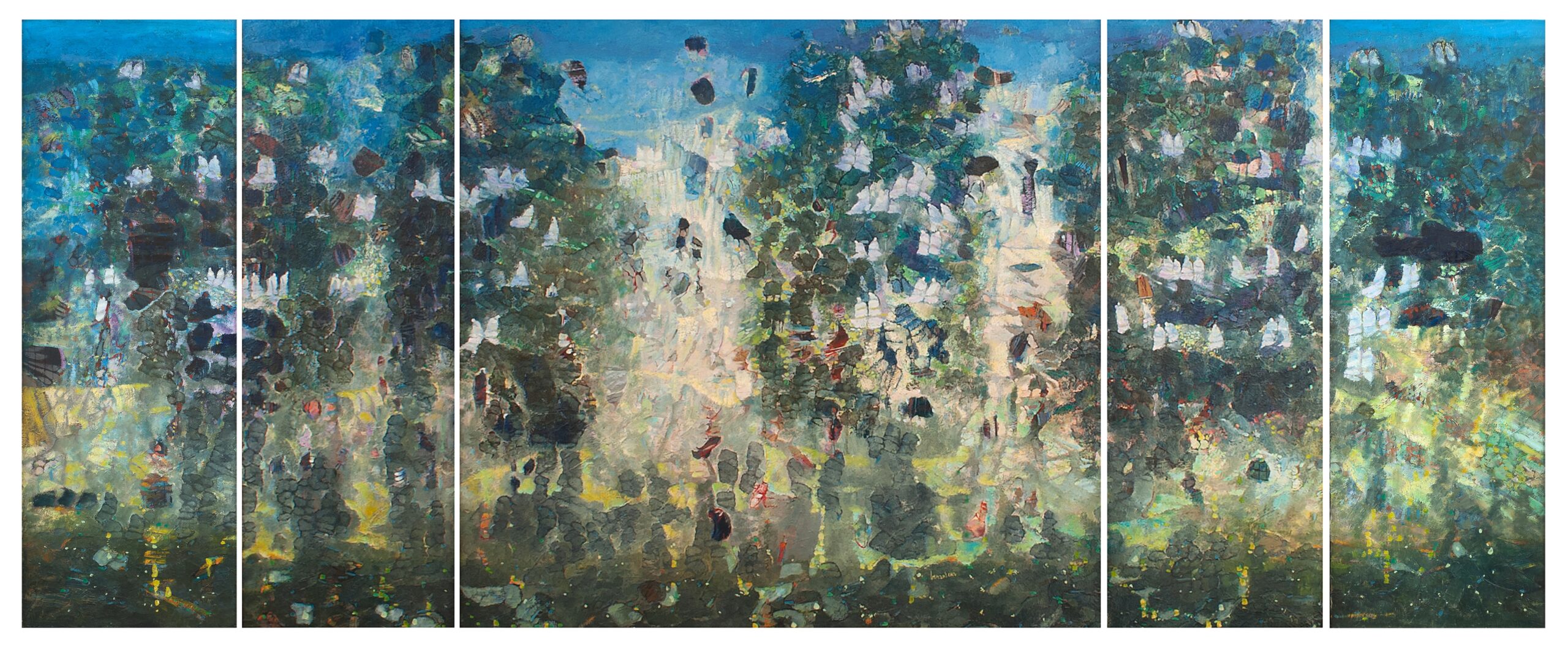
BENANTEUR, Les Elus, 1986. Polyptych. Oil on canvas, 150 x 350 cm. IMA Museum. Donation Claude & France Lemand. © Abdallah Benanteur Estate. Courtesy Galerie Claude Lemand, Paris.
Claude Monet, A Legacy of Gardens.
Les Franciscaines, Deauville, France.
Exhibition from July 11 to November 1st, 2026.
Les Franciscaines:
Monet, A Legacy of Gardens
One hundred years after the death of Claude Monet (1840-1926) on December 5, 1926, in Giverny, Normandy is paying tribute to him in numerous ways. At the heart of this program, the Musée Les Franciscaines in Deauville offers a sensitive and contemporary reinterpretation of the legacy of the painter of the Water Lilies, placing his work in dialogue with that of artists around the world who share the same fascination with light, gardens, and color. Drawing on exceptional loans from the Musée d’Orsay, the Musée Marmottan, the museums of Dreux and Saint-Étienne, and the Institut du monde arabe (Claude & France Lemand Donation), the exhibition creates a dialogue between Monet and those who claim him as an influence: the Algerian Abdallah Benanteur, the Japanese Reiji Hiramatsu, the Canadian Jean-Paul Riopelle, and the photographers Jean Gaumy, Bernard Plossu, and Jorma Puranen.
Claude Lemand:
Benanteur, The Chosen cycle
Born in 1931 in Mostaganem, Abdallah Benanteur grew up in an Algerian family and cultural environment steeped in writing and illuminated manuscripts, Muslim mystical poetry, and Andalusian music and song. After studying at the School of Fine Arts in Oran, he settled in Paris in 1953, which became his home and creative center. He passed away on December 31, 2017, in Ivry-sur-Seine, France.
Despite the historical backdrop of a colonial war with tragic consequences and the unfavorable social circumstances in which he lived, Abdallah Benanteur (Algeria 1931-France 2017) was the only artist from the Arab world to integrate the spirit of Claude Monet’s Water Lilies into his own work so early and so profoundly. Comprising a polyptych and two triptychs of identical dimensions, 150 x 350 cm (Les Élus, L’Élu, and Les Élus du soir), the Élus cycle is a symphonic work made up of three movements that echo and complement one another. It stands as Benanteur’s tribute to the great monumental works of classical European painting and, above all, as the culmination of a thirty-year dialogue with the Water Lilies at the Musée de l’Orangerie, a vast cycle of paintings conceived and executed by Claude Monet as the “Monument to the Fallen and to Peace” that he wished to gift to France. He had promised it to his friend Georges Clemenceau, a patriotic and universalist politician, a staunch anti-colonialist and anticlerical, and a man passionate about Art and Buddhist thought.
The Élus (The Chosen) cycle represents a pinnacle of Benanteur’s career, the finest “Monument to the Fallen for Algerian Independence and the End of Colonialism,” and a hymn of hope that the Life instincts of fragile Humanity will prevail over Death instincts, finally ushering in the long-awaited universal peace and brotherhood of a planetary Garden of Eden. Visitors will be able to make a pilgrimage to view the work in the Salle des Élus, a room dedicated to it within the Institut du monde arabe museum’s new exhibition layout, as a place of memory, reflection, contemplation, and aesthetic appreciation.
BENANTEUR, Les Elus, 1986. Polyptych. Oil on canvas, 150 x 350 cm. IMA Museum. Donation Claude & France Lemand. © Abdallah Benanteur Estate. Courtesy Galerie Claude Lemand, Paris.
Les Élus (The Chosen), 1986. Polyptych. Oil on canvas, 150 x 350 cm.
A vast, peaceful landscape traversed by broad, white, ethereal, and diaphanous openings, reminiscent of Claude Monet’s Water Lilies series of 1907-1908. It depicts the gentle, successive waves of the resurrection of the dead. Nature and humanity are caught in an upward movement through a paradisiacal garden (of forms, colors, and light), ascending toward the sky. While some of the chosen appear alone, they are more often grouped in twos, threes, or larger clusters. They seem happy to be reunited, floating in bunches around the branches. All dressed in white and bearing no distinguishing gender markers, The Chosen are believed to represent the Algerian fighters who died for their country’s independence.
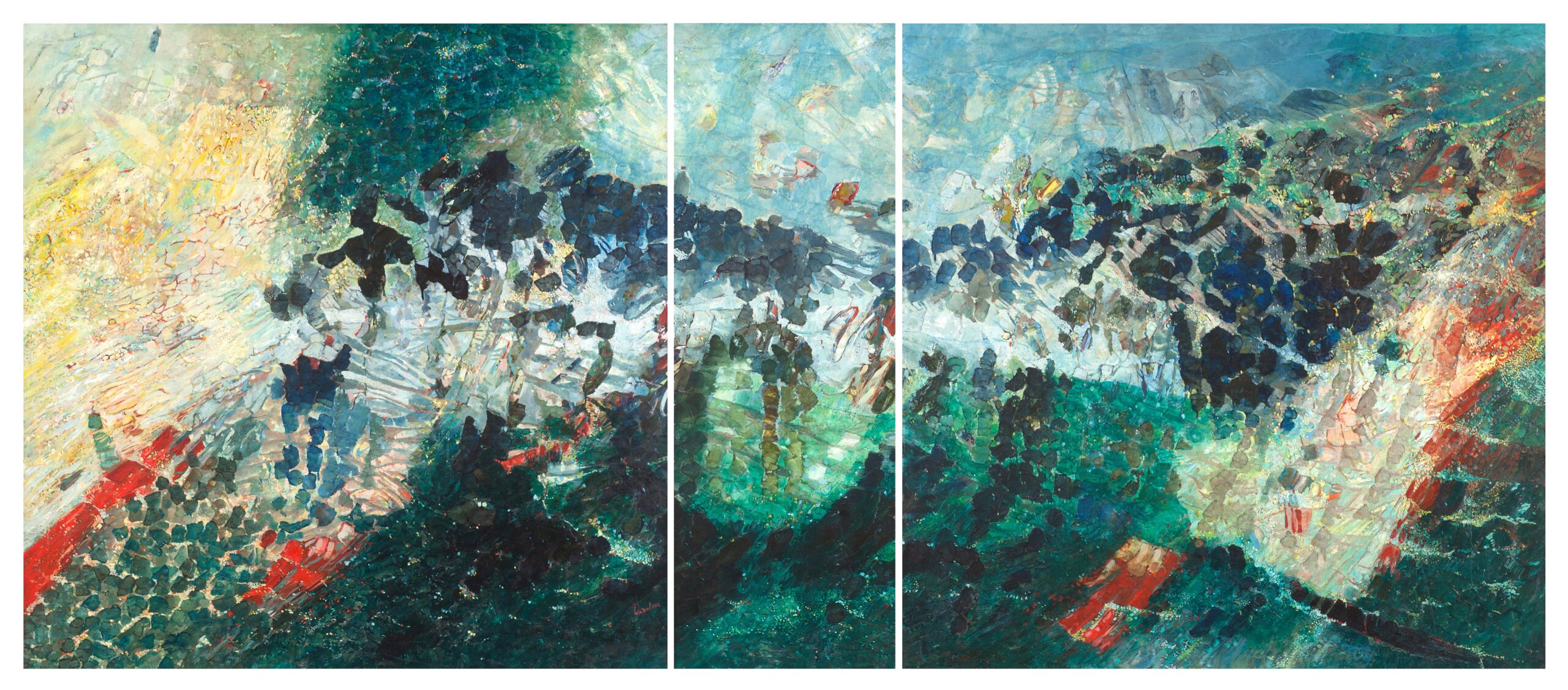
BENANTEUR, L’Elu, 1987. Triptych. Oil o canvas, 150 x 350 cm. IMA Museum. Donation Claude & France Lemand. © Abdallah Benanteur Estate. Courtesy Galerie Claude Lemand, Paris.
L’Élu (The Chosen One), 1987. Triptych. Oil on canvas, 150 x 350 cm.
The landscape depicted is that of Algeria, caught in a seismic upheaval, an image of its anti-colonial uprising and war of independence, featuring erupting volcanoes and the spewing of lava and earth into the ocean. The Chosen One is clearly identified as Charef, Abdallah’s younger brother, who died in battle on Algerian soil; he is depicted weightless and dressed in radiant attire, like an apparition at the very top of the central panel, conversing with his older brother, who stands atop the mountain, seen from behind and wearing a traditional red chéchia. The Chosen One holds great symbolic importance, contrasting with the very small amount of space he occupies within the triptych; the work is almost entirely filled by the landscape, the vast Algerian “Nature” that bears The Chosen One. This approach differs from European painting, where figures of the Christian faith take center stage and fill nearly the entire space, yet it aligns with Chinese and Japanese painting, where the minuscule scale of human figures conveys the immensity of the Nature of which they are a part and which they do not dominate.
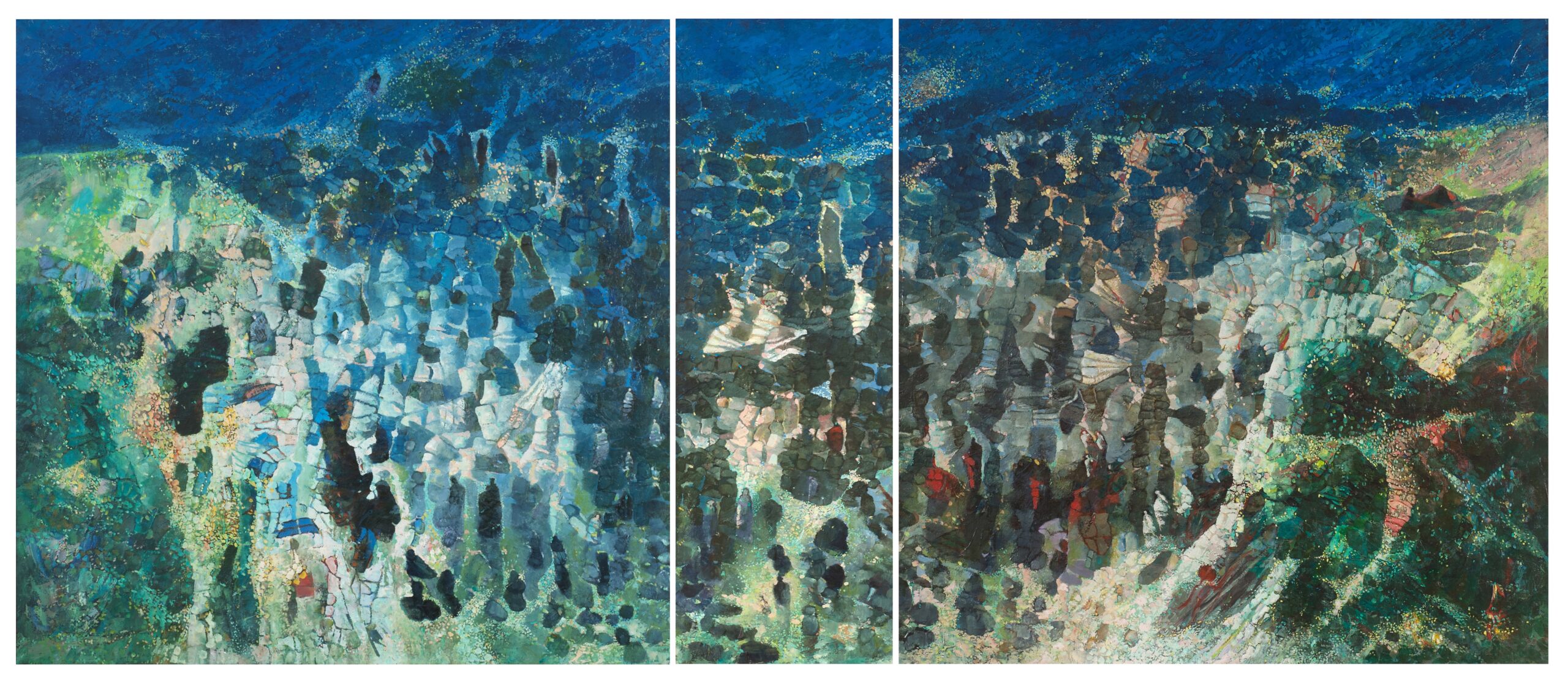
BENANTEUR, Les Elus du soir, 1987. Triptych. Oil on canvas, 150 x 350 cm. IMA Museum. Donation Claude & France Lemand. © Abdallah Benanteur Estate. Courtesy Galerie Claude Lemand, Paris.
Les Élus du soir (The Chosen of the Evening), 1987. Triptych. Oil on canvas, 150 x 350 cm.
The telluric movement continues, but is now subdued. Figures rise amidst nocturnal hues, and the atmosphere remains dramatic. Les Élus du soir is dedicated to the French citizens and foreign nationals who campaigned for Algerian independence, for justice and peace. The dead are depicted in white; the more numerous living are in blue. In interviews, Benanteur often spoke of his ideal of equality and fraternity among all human beings. These Chosen of the Evening represent the “laborers of the eleventh hour” from the Gospel parable (Matthew 20:1–16): hired at the end of the day, they work for only a single “hour”, yet when evening falls, the master of the vineyard pays them a full day’s wage. Thus, the humanist and universalist Abdallah Benanteur asserts that the French citizens and international activists who stood in solidarity are equal to the Algerian martyrs and deserve to be honored in the same way.